
Start a small game, one intersection at a time
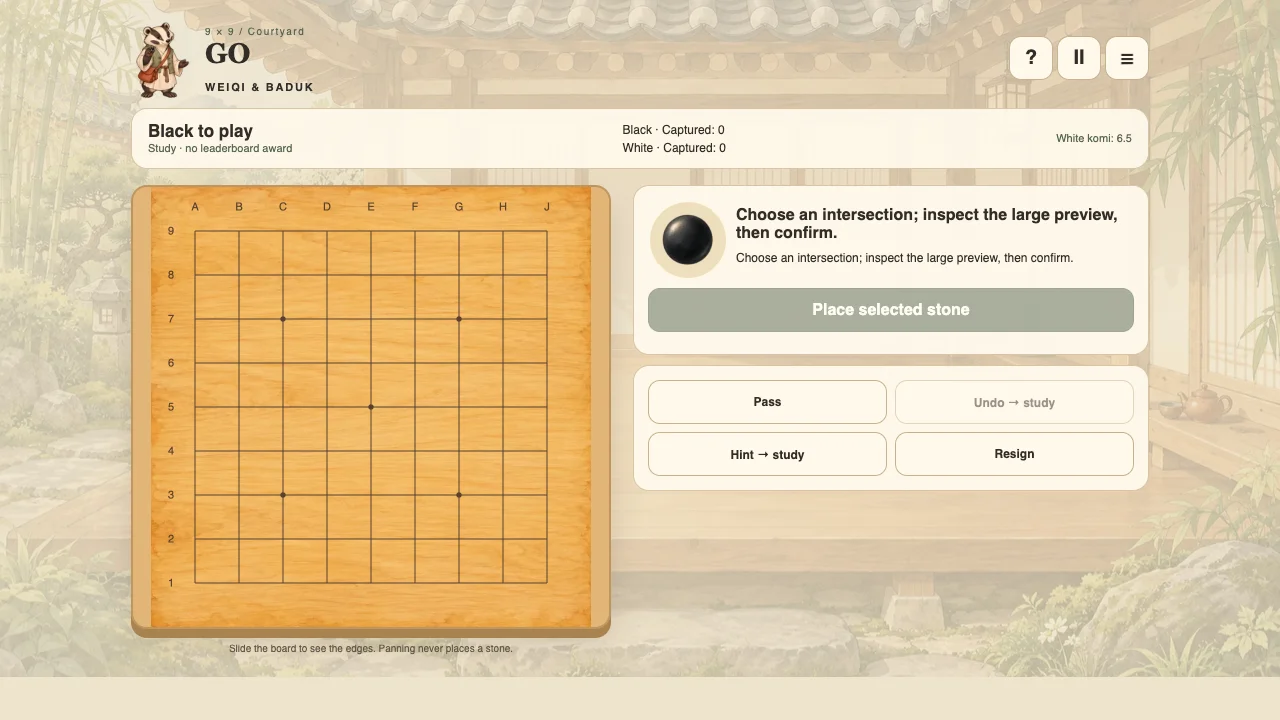
Choose the beginner bot for an offline opponent or Two players, one device for local study. Select an intersection, inspect the enlarged preview and confirm with Place selected stone. Moving the board view does not place a stone. Black plays first. Unlike chess, an ordinary placed stone stays where it is until captured.
A 9×9 board has 81 intersections, including points on its outer border. The lines are not squares to fill. You do not flip enemy stones as in Reversi, and captures are a means of gaining space rather than the sole aim. Start by keeping neighboring stones connected and watching whether your opponent can surround them.
Count liberties, including shared ones
Only horizontal and vertical connections count. Diagonally touching stones are separate groups. A liberty is an empty point next to any stone in a connected group, counted once even if two stones touch it.
| Example | Position | What it teaches |
|---|---|---|
| Center | Black at E5, all surrounding points empty | Four liberties: D5, F5, E4, E6. |
| Corner | Black at A1, B1 and A2 empty | Two liberties. The board edge provides no extra point. |
| Connected pair | Black at E5 and F5, no other stones nearby | Six distinct liberties: D5, E4, E6, G5, F4, F6. |
| Atari | Black E5; White D5, F5, E4 | E6 is Black's last liberty. White E6 captures E5 if the move is otherwise legal. |
“Atari” means a group has one liberty left. Extending into that last point may help, but count the resulting group's liberties before confirming. A larger group can still be surrounded.
Practice one capture in local study
On a fresh local board, try Black E5, White D5, Black A1, White F5, Black A2, White E4, Black B1, White E6. Black's E5 stone disappears because its four adjacent intersections are occupied by White. The corner moves are deliberately quiet moves for this exercise, not an opening recommendation.
Capture checks happen before the new stone's liberties are assessed. A move that removes an opposing group can become legal because the captured points provide air. A move that still leaves your own group without liberties is rejected as suicide.
Understand the version's repetition rule
A simple ko shape can tempt you to immediately take back the capturing stone. This version uses positional superko: a placement may not recreate any earlier board position in the game history. Play elsewhere to change the position before considering a recapture; that does not guarantee every later recapture is legal. A snapback capture is different when it creates a genuinely different board.
The built-in lessons cover ko, snapback, shared liberties and eyes. Use them when a local shape is confusing. Hint and Undo switch a bot run to study; they are learning tools rather than unassisted ranked play.
Finish with two passes and area scoring
Pass when you believe further moves do not improve your position. Two consecutive passes begin review. In local study, both players must agree about marked dead groups. If a group's status is uncertain, resume play instead of guessing it dead.
Area scoring adds your remaining stones to empty regions surrounded only by your color. Empty regions touching both colors are neutral. White then receives 6.5 komi. For example, 30 Black stones plus 12 enclosed points gives 42; 28 White stones plus 10 enclosed points and 6.5 komi gives 44.5, a White win by 2.5. Captured prisoners are not added as a separate area-scoring bonus.
Beginner questions
Can I play a 19×19 game or invite someone remotely?
This game is a 9×9 beginner bot and local study experience. The local option uses the same device; it is not an online matchmaking room.
Should I chase every capture?
No. Compare the space you gain with the liberties and connections you give up. For another intersection-based board game with moving pieces, read our Xiangqi beginner guide.