
Read the river and palace first
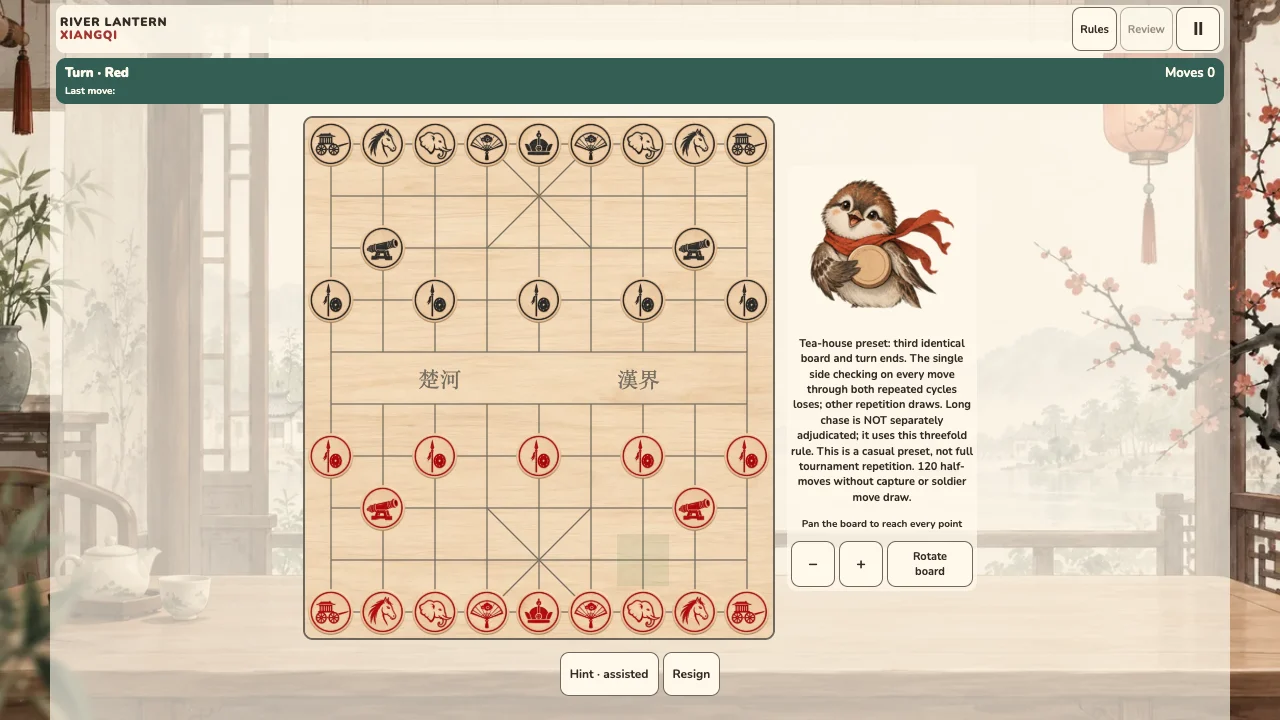
River Lantern shows Red at the bottom by default. Red's soldiers advance toward the top; Black's advance toward the bottom. Pieces stand on line intersections. Each side's palace is the central 3×3 area at its end. The river separates the fifth and sixth ranks.
Select a friendly piece and inspect the legal destinations before confirming a move. Rotate and pan the board if you need a clearer view. Use Two players for a shared-device game or choose a bot level for practice. A hint highlights a move without making it; hints and study branches are assisted practice.
How all seven piece types move
| Piece | Ordinary movement | Restriction to remember |
|---|---|---|
| General | One point horizontally or vertically | Stays in the palace; generals may not face each other on an unobstructed file. |
| Advisor | One point diagonally | Stays in the palace. |
| Elephant | Two points diagonally | Cannot cross the river or jump a piece on the middle diagonal point. |
| Horse | One orthogonal step, then one diagonal step outward | The first orthogonal point, called its leg, must be empty. |
| Rook | Any distance horizontally or vertically | Cannot pass through another piece. |
| Cannon | Moves without capture like a rook | To capture, jumps exactly one intervening piece, called a screen. |
| Soldier | One point forward | After crossing the river, may also move one point sideways; never backward. |
Why a horse or elephant cannot move
For an original example, label files A–I left to right and ranks 1–10 bottom to top. A Red horse on B1 could reach A3 or C3 only when B2 is empty. A friendly or enemy piece on B2 blocks both of those moves. Its possible move to D2 instead depends on C1 being empty. Unlike a Western chess knight, a Xiangqi horse does not simply jump everything.
A Red elephant on C1 reaches E3 only if D2 is empty. D2 is its elephant eye. Even with an empty eye, an elephant may not land across the river. A destination can also be illegal because moving the piece would expose the general to check.
Count cannon screens carefully
A cannon with a clear line can move to an empty point, but cannot capture an enemy on that same clear line. A capture needs exactly one occupied point between cannon and target. The screen may belong to either side. Two intervening pieces block the capture.
Before moving a screen, inspect both generals. Removing your last piece between the generals can open an illegal facing-generals line. Adding a piece to a cannon line can unexpectedly create an attack; adding a second screen can remove one.
Answer check and understand the ending
You may not leave your general in check. Look for a legal general move, a capture of the attacker, or a block against a rook or cannon line. A horse attack can sometimes be stopped by blocking its leg. River Lantern ends the game when the side to move has no legal moves: stalemate is a loss in Xiangqi, unlike the usual Western chess draw.
This game's tea-house repetition preset ends on the third identical board with the same side to move. If exactly one side checked on every one of its moves through both repeated cycles, that checking side loses; other such repetitions draw. Long chase is not adjudicated separately. A sequence of 120 half-moves without a capture or soldier move also draws. These are this casual game's rules, not a complete tournament repetition code.
A useful first practice routine
- Open a practice game and inspect each starting piece's legal destinations.
- Move a soldier forward, then compare a horse whose leg has opened with one whose leg is blocked.
- Look at a cannon line and count screens before attempting a capture.
- After every opposing move, ask whether your general is checked before planning an attack.
Try the built-in tactics when you want a short position rather than a whole match. If you prefer placing stones instead of moving pieces, our 9×9 Go guide explains liberties and captures.