Choose Classic Beach and make a first dig
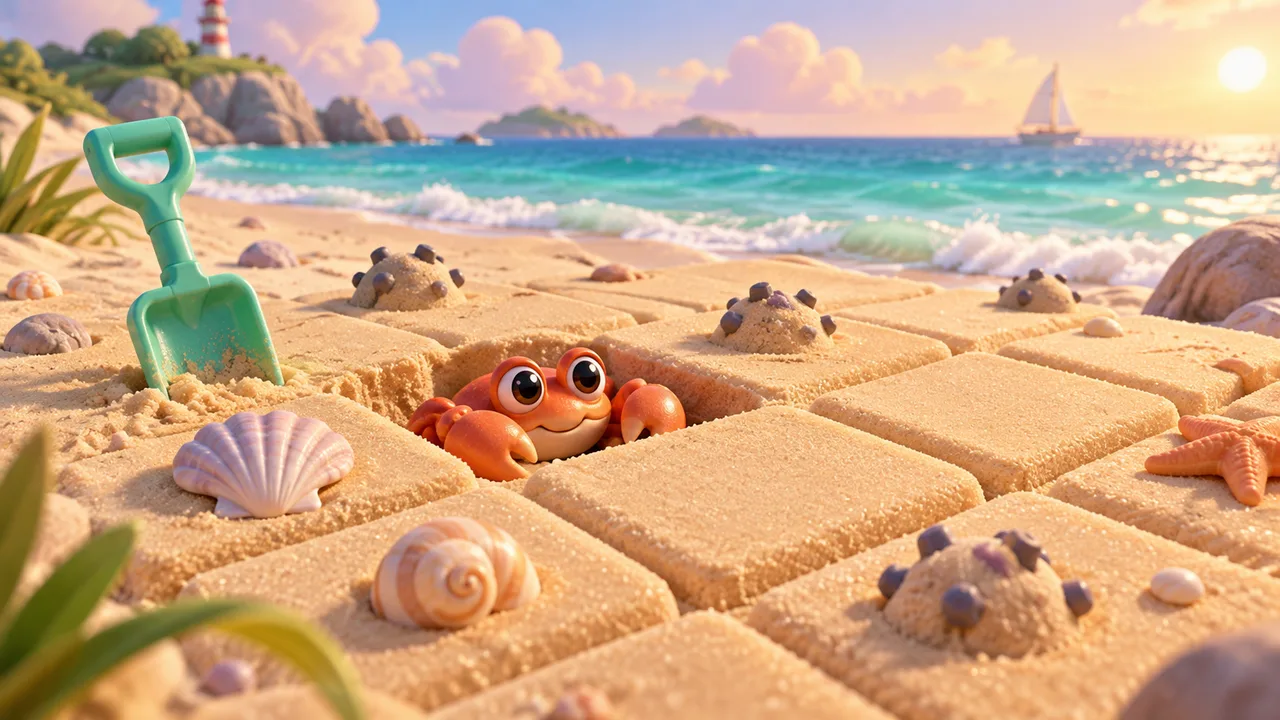
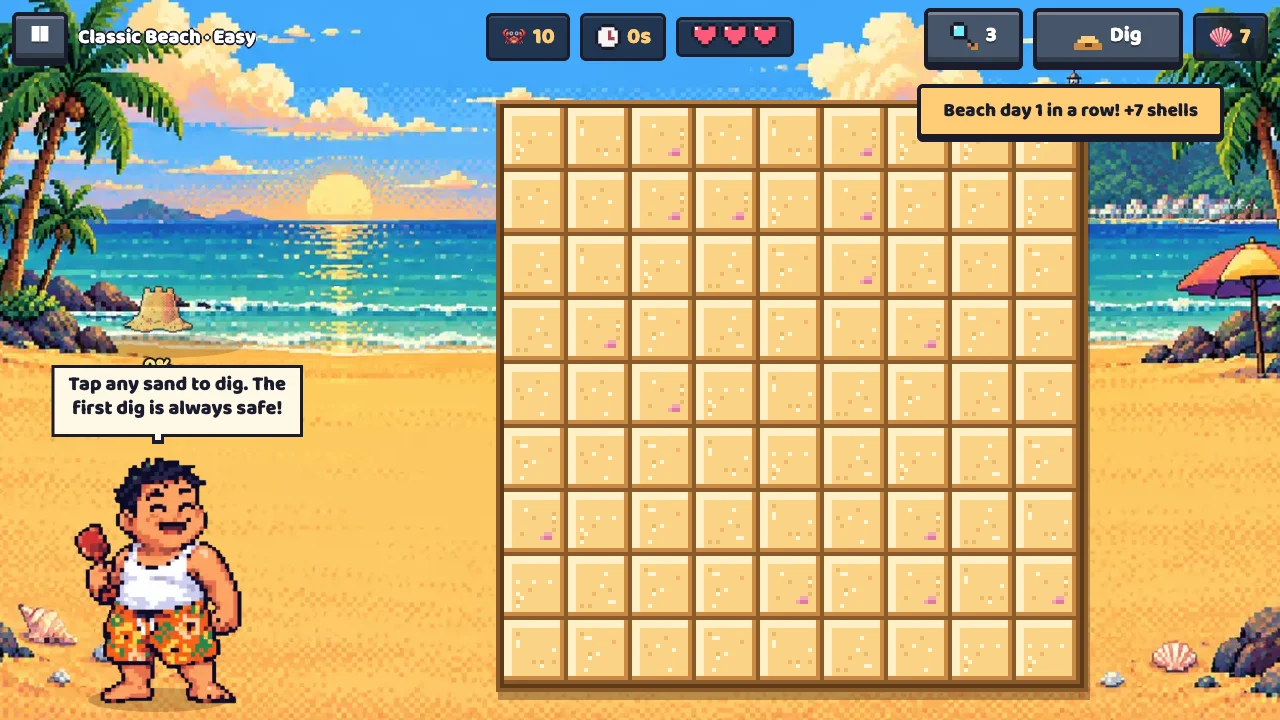
Start with Classic Beach · Easy, a 9×9 board with 10 crabs and three hearts. Left-click or tap digs. Right-click or long-press plants a spade; the Dig/Spade toggle changes what an ordinary tap does. On a keyboard, arrows move the cursor, Space digs and F marks a spade.
The first dig is protected. An empty area can open several cells at once, giving you a border of numbers to read. A crab costs a heart in this version, so the first mistake does not always end the run. Hearts are a recovery allowance, not evidence that a random cell is safe.
Count all eight neighbors
For a number at the center of a 3×3 patch, inspect the three cells above, the two cells beside it and the three below. Edge numbers have fewer neighbors because points outside the board do not exist. Revealed safe cells contribute no hidden crab.
| Visible state | Deduction | Action |
|---|---|---|
| A 1 has exactly one covered neighbor and all its other neighbors are revealed. | That covered neighbor contains the single crab. | Plant a spade there. |
| A 2 has two correctly marked crabs and one other covered neighbor. | The count is already satisfied. | The other covered neighbor is safe to dig. |
| A 1 has two covered neighbors and no other information. | One is a crab, but the number alone does not identify which. | Read another nearby clue instead of inventing certainty. |
Combine clues without guessing
Suppose clue A needs one crab among covered cells X and Y. A neighboring clue B needs one crab among X, Y and Z, with all its other neighbors already safe. The one crab needed by B is already accounted for somewhere in X and Y, so Z is safe. You still do not know whether X or Y is the crab.
If instead B needs two crabs among X, Y and Z, Z must be a crab. This works only when you have compared the exact covered sets and adjusted for correctly marked crabs. A familiar-looking 1–2 pattern is not enough if extra covered neighbors change those sets.
Use speed-dig only after checking flags
Tapping a revealed number can speed-dig its remaining neighbors when its crab count is marked. Keyboard C performs the same action at the cursor. This saves time, but a wrong spade can cause the game to open a real crab. The number of spades matching the clue is not proof that their locations are correct.
Before using it, trace the reason for each neighboring spade. If one was only a guess, inspect another clue or use a magnifier if available. The magnifier is a limited tool for a safe logical deduction, not a reason to skip learning number relationships.
Separate the modes and settings
Classic Beach has a No-guess boards setting. Daily Beach, Beach Trip and Tide Rush have their own generation and objectives; Tide Rush adds time pressure from the incoming sea. The menu's no-guess setting does not make every arbitrary Minesweeper board solvable without a guess.
For a first learning session, use Classic with the no-guess option and take time over each clue. This guide checks the basic number and marking rules; it does not independently certify every generated seed or every difficulty.
What if I cannot prove a move?
Look at another border, combine neighboring clue sets, check for a mistaken spade or use the game's available hint tool. “No deduction found yet” and “this cell is safe” are different conclusions. For another puzzle that combines row and column evidence, read how to play Nonogram.