
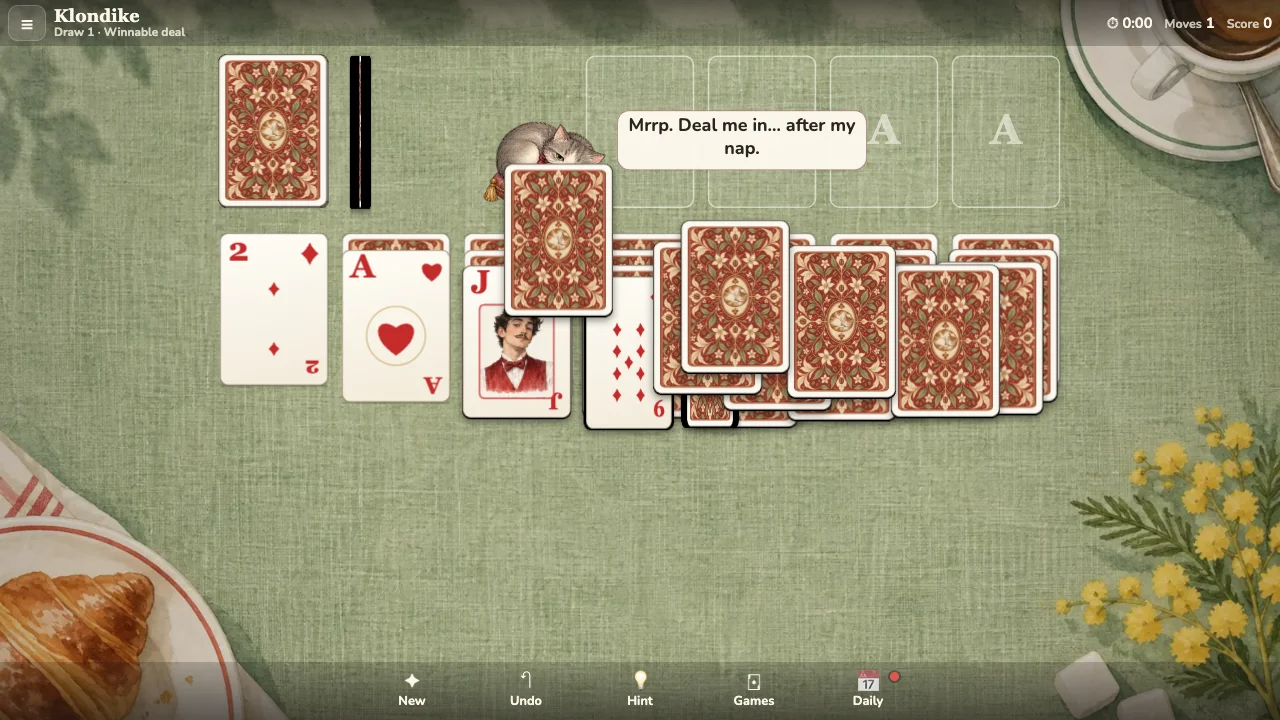
Know the four parts of the table
FunGameHouse's Solitaire collection opens with Klondike. The seven descending columns are the tableau. Their hidden cards become available when you move the face-up cards above them. The face-down reserve is the stock; its exposed cards form the waste. The four foundations collect each suit from Ace upward.
The game also contains other solitaire variants. Select Klondike when following this guide: Spider's same-suit runs and FreeCell's storage cells are different rules, not extra Klondike moves.
Make a legal tableau move
A red 9 can go on a black 10. A black 9 cannot go on that black 10, and a red 8 cannot skip the 9 to land directly on the 10. You can move an ordered stack together when it descends by one rank and alternates color all the way down.
For example, a red Queen followed by a black Jack and red 10 can move together onto a black King. If a hidden card was underneath that stack, moving the stack reveals it. The new card may open another move, so inspect it before drawing again.
An empty tableau column accepts a King, including a valid stack headed by a King. It is not a free space for any card. Before creating an empty column, look for a King you can actually place there and consider which hidden card that move reveals.
Build foundations by suit
An Ace starts an empty foundation. The next card must be the 2 of that same suit, then its 3 and so on. A red heart and a red diamond are different suits, even though they share a color. Tableau uses color; foundations use suit.
Sending every available high card upward immediately is not always the most useful plan. A card may still be helping you move a lower tableau stack. The game provides Undo so you can compare the consequences of a move without restarting the whole deal.
Draw 1 and Draw 3
Draw 1 exposes one stock card at a time, making it easier to inspect and use each card. Draw 3 exposes up to three, but only the top accessible waste card can move; removing it can reveal the card below. You cannot choose any visible card buried in the waste fan.
In normal Klondike, stock recycling is allowed without a fixed pass limit, though scoring can change. The optional Vegas scoring preset limits passes and uses points with no cash value. Check the selected mode and options before assuming a rule from another Solitaire app applies.
A practical first-deal routine
- Look for an Ace that can start a foundation.
- Look for a legal tableau move that reveals a face-down card.
- Consider an empty column only if a King can use it.
- When no useful visible move remains, draw from the stock and inspect its top waste card.
- After a move reveals a card, rescan the tableau before drawing again.
Drag cards to choose a destination explicitly. Tapping can send a card to its best available spot, but a manual drag is clearer when you are learning why a move is legal. Keyboard D draws, H requests a hint and Ctrl+Z undoes.
When a deal seems stuck
Use Hint to inspect a suggested move, or Undo to revisit a choice that closed a useful route. Cycling the stock without changing the board eventually repeats the same options. A “winnable deal” label means a solution was selected by the game's deal system; it does not mean every sequence of player choices wins.
Use New when you want a fresh deal or restart the current one from the menu for practice. For a slower tile-removal puzzle instead of cards, read the Mahjong Solitaire rules.