

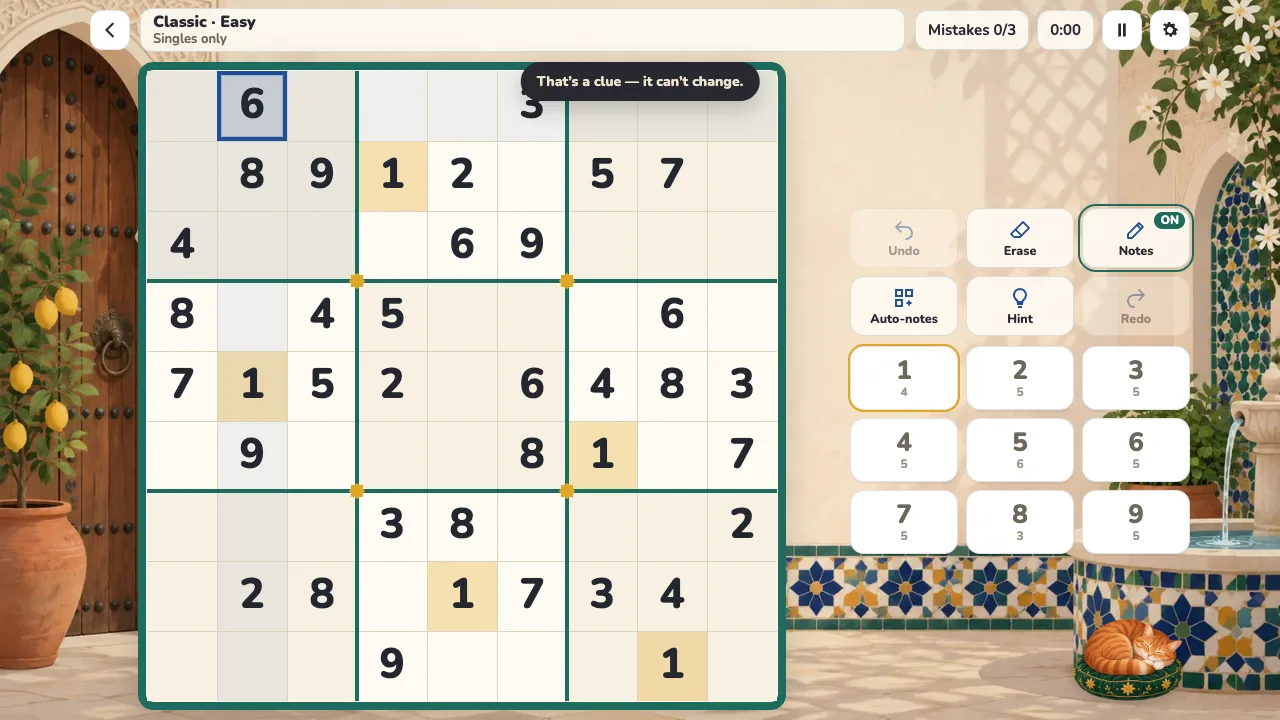
Check a row, a column and a box
A digit that is absent from the row can still be illegal because it appears in the column or box. Look at all three groups before filling a cell. Printed starting digits are clues; use the editable cells to complete the puzzle.
Work through a missing-number example
Consider a row with 1, 2, 3, 4, 5, 6, 7, 8, blank. Its missing digit is 9. Check that the blank’s column and box do not already contain 9, then enter it. This is a teaching example, not a solution to today’s daily puzzle.
Now consider a row missing 2 and 7. For one empty cell, suppose its column already contains 7. That cell cannot be 7, so it must be 2, provided its box allows 2. The other empty cell then becomes 7. This is elimination: each restriction narrows the possibilities.
Use pencil marks to remember candidates
- Select an empty cell and switch to Notes.
- Record only digits that remain possible after checking its row, column and box.
- After placing a definite digit, revisit notes in the affected groups.
- When only one candidate remains, switch back to normal entry and fill the cell.
Notes are possibilities, not answers. A cell with notes 2 and 7 means you have not yet proved which one belongs there. Filling a candidate merely because it feels likely can send the rest of the puzzle down a wrong path.
A useful beginner routine
Choose an easy Classic puzzle first. Scan nearly completed rows, columns and boxes for missing digits, then look for cells with one remaining candidate. If you stop making progress, inspect another part of the board before guessing. Use a hint as a lesson: identify the restriction that made the hinted digit possible.
The FunGameHouse version
Sudoku Daily includes Classic puzzles and separate variants. Start in Classic for the rules described here. A variant may add another restriction, so read its explanation before applying Classic-only assumptions. Mouse or touch selects a cell; the visible number pad lets you enter a digit. Notes and erase are separate tools.
Common questions
Do I need to be good at maths?
No. The digits are symbols for nine different values; you do not add or multiply them.
Can I repeat a number in different boxes?
Yes, if it does not repeat within a row, column or individual box. Each box needs its own 1–9 set.
Why is my row correct but the digit still wrong?
The column or 3×3 box can rule it out. A placement must satisfy all three groups.
Should I guess when I have two candidates?
First look for more information elsewhere. Two notes show uncertainty; they do not prove either candidate.